


Why context matters as AI Coding scales
AI coding assistants have become a normal part of many development environments. They speed up routine work. Teams ship faster. For many engineers, these tools already feel indispensable.
In pilot setups and at team level, the benefits are often immediately visible. Tasks that once required extended focus can now be completed in shorter cycles. Exploration becomes easier. Documentation no longer gets postponed.
Yet, as adoption spreads across teams and systems, a more nuanced reality begins to appear. Many teams discover that early productivity gains are hard to sustain. They are confronted with inconsistent results, architectural drift, rework and growing coordination overhead across teams, domains, platforms.
This is not a contradiction. It reflects the natural limits of applying AI in environments where context is distributed and evolving.
The conversation, in many organizations, is quietly shifting. Less time is spent debating how fast AI can generate code. More time is spent on one powerful question: How to create the conditions for AI to operate effectively at scale?
AI Coding Assistance is strong (within its boundaries)
Scaling AI Coding Means Scaling Shared Understanding
Where AI Productivity Gets Lost Silently
Productivity gaps emerge as adoption scales
Shifting the Perspective
From Promise to Practice
AI Coding Assistance is strong (within its boundaries)
AI coding assistants have proven their value in everyday development. Their strengths are widely recognized. Different tools focus on different areas, but common capabilities stand out:
- Fast code generation
- Debugging support through error interpretation and suggested fixes
- Test and documentation creation
- Refactoring and quality improvements
- Knowledge access and learning support
These capabilities reduce cognitive load. They accelerate iteration. They help engineers move forward when uncertainty arises.
However, in multi team, multi project environments context expands beyond what any single engineer or prompting can reliably contain.
Patterns begin to emerge:
- Similar problems are solved differently across teams
- Architectural principles are interpreted in multiple ways
- Review efforts increase rather than decrease
- Prompting strategies diverge, leading to inconsistent results
None of these observations imply that AI underperforms. They highlight something else. Enterprise-grade software development has always required shared understanding. AI does not eliminate this requirement.
So, what happens when implementation becomes easier, but alignment remains complex?
Scaling AI Coding means scaling shared understanding
Enterprise software development rarely happens in isolation. Multiple teams contribute to shared codebases. Architectural decisions live longer than individual projects. Standards evolve. Dependencies span domains.
In such environments, AI-generated output becomes part of a larger system. Consistency matters as much as speed.
Engineers frequently observe:
- Increased variation in implementation styles
- More time spent aligning decisions across teams
- Greater effort required to preserve architectural intent
- Rising importance of documentation that was previously implicit
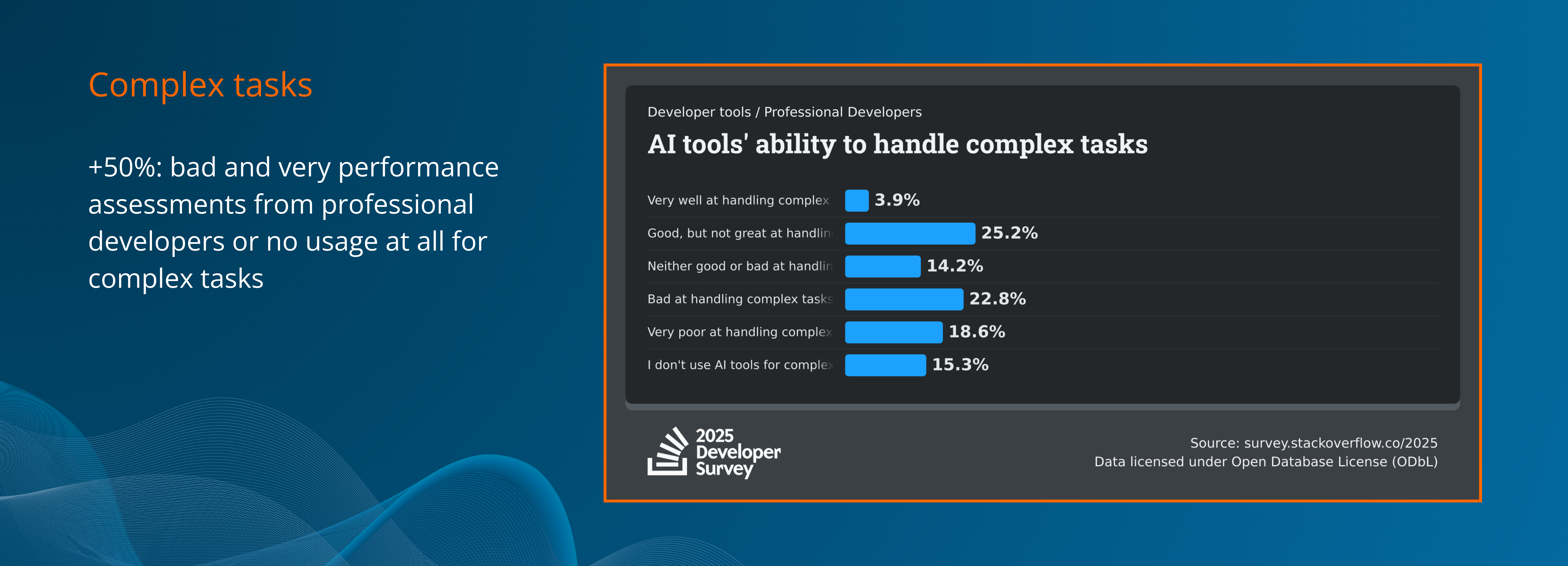
Source: Developers | 2025 Stack Overflow Developer Survey
These experiences do not indicate friction caused by AI. They reveal the growing importance of shared context.
Decisions that were once shaped through conversation are now shaped through interaction with tools. Without explicit guidance, interpretations naturally diverge.
Where does shared understanding live when more contributors (human and AI) shape the system simultaneously?
Where AI Productivity gets lost silently
Many organizations begin to recognize that AI effectiveness depends on the clarity of shared design intent.
Some of the productivity gained through coding assistance is absorbed in less visible ways:
- Additional alignment conversations
- Clarification loops
- Post-implementation corrections
- Review cycles that focus on coherence rather than correctness
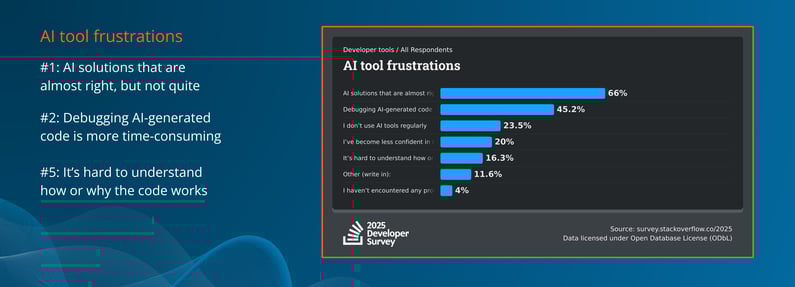
Source: Developers | 2025 Stack Overflow Developer Survey
These effects often remain unnoticed at first. They rarely appear in metrics. Yet they influence how progress feels across teams. Earlier experimentation with AI emphasized speed and exploration. Today, attention is gradually expanding toward other aspects:
- Making architectural decisions explicit
- Creating shared language across teams
- Treating design artifacts as evolving assets
- Ensuring implementation reflects collective intent
This shift does not reduce the value of AI. It highlights the interplay between human coordination and machine assistance.
Productivity gaps emerge as adoption scales
In smaller or mature teams, shared understanding often develops naturally. Communication is direct. Architectural decisions are easier to trace. Informal alignment is usually sufficient.
Under these conditions, context is implicitly shared.
As more teams contribute to the same systems, maintaining this implicit alignment becomes harder:
- Standards are interpreted differently
- Local decisions affect distant parts of the system
- Review cycles expand
- New contributors need more time to understand past decisions
At this stage, design begins to serve a role beyond documentation. It becomes a shared reference point. A coordination layer. A way to make intent visible.
This is not about introducing control. It is about enabling clarity that supports both human engineers and AI systems.
Shifting the perspective
Coding assistance is now part of everyday development workflows. AI coding assistants are here to stay.
With this reality established, the perspective begins to shift. The central question is no longer whether to adopt these tools. It becomes how organizations realize their full value over time - especially in environments where many teams contribute to shared systems.
For those responsible for engineering resources, some questions naturally emerge:
- Where does alignment effort absorb potential gains?
- How explicit is design intent across teams?
- What forms of shared context exist today and which remain implicit?
These questions invite reflection rather than immediate answers. They open a space for reflection on how productivity, coherence and collaboration evolve together.
From Promise to Practice
What is your experience? Is the scalability of AI coding assistance being addressed as a value and risk question?
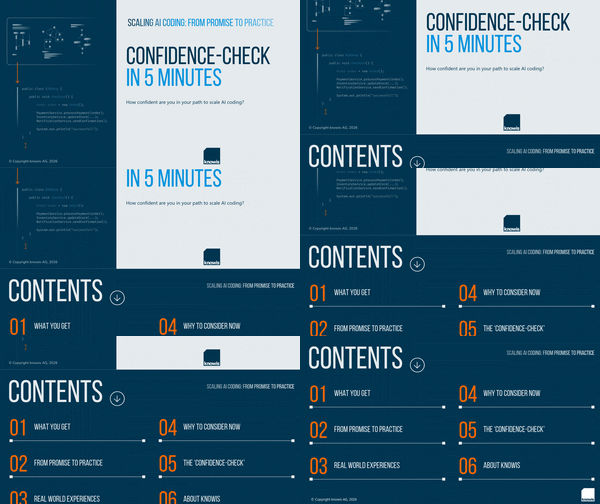
We have developed a context and confidence check to support informed discussion. 👇
Explore the topic and assess its relevance together with your peers.
We hope this sparks thoughtful discussion and welcome your comments or questions.